
Remarks for the dedication of the Benny Gordon Recreation Center – May 16, 2026
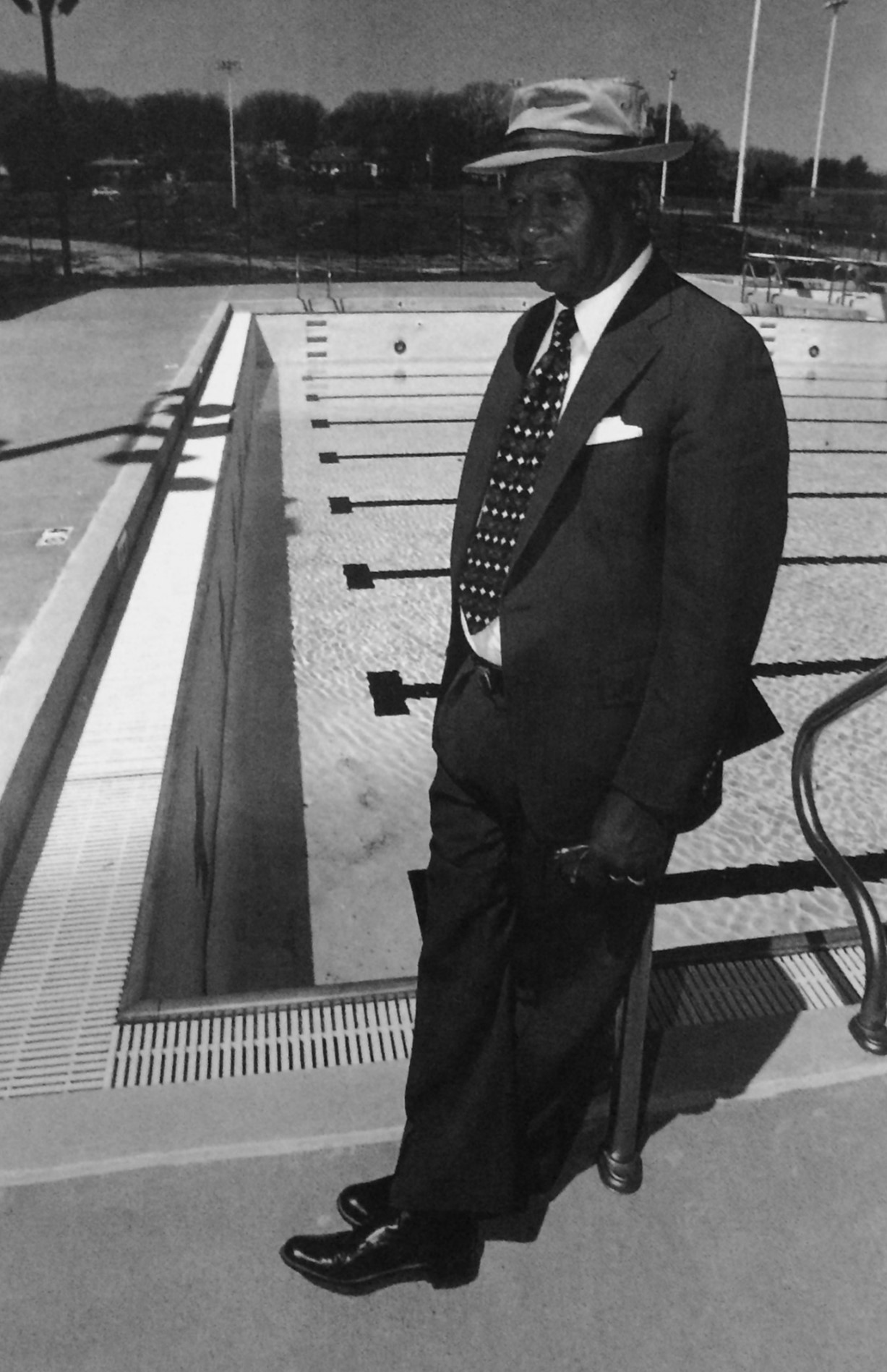
Here is the speech I offered at the dedication of the Benny Gordon Recreation Center in Webster Groves, on May 16, 2026. I preceded these remarks with some brief facts and figures about the effort Mr. Gordon led, 1949 – 1953, to integrate the Webster Groves municipal pool.
I am David Denoon. I’m a resident of Webster Groves and the pastor of the First Congregational Church, United Church of Christ. It is my honor and pleasure to have been invited to this dedication ceremony, to speak about Bennie Gordon, Jr.
A few years ago at City Hall, we named a room after him. Today, we’re naming an entire recreation center. It is fitting to do so, and I’ve got fliers about why, which you might find interesting. But the presenting cause for naming a recreation center after him is not why I’ve been asked to speak. I am here to talk about Bennie Gordon the businessman who was a picture of insuperable courage and indefatigable spirit.
I never met Mr. Gordon in person, but I have come to know his family, and by knowing them I presume to understand what he was like. You see, for many years I simply knew Bennie Gordon, Jr., as the activist who spearheaded the desegregation of the Webster pool, from 1949 to 1953. That fact and a few others are what are represented on my handout.
But it was in 2023 that I discovered the Bonds family who joined my Congregation in 1957. The way I came to know them was that, at Thanksgiving 2023, an individual who had grown up in my church brought a photo album of class pictures from the First Congregational Sunday School of that era – to be placed in our historical archives. (We did that sort of thing, back then.) In the Kindergarten photo was a group of probably 20 children, all but one of whom was white. That one child was a girl, who, the photo said, was named Kassandra Bonds. Same with second, fourth, and sixth grade. The 8th Grade picture did not include Kassandra but did include her mother who taught that age level. This was Thyra Bonds.
Being an innately curious pastor, I eventually went to my computer and typed Thyra Bonds’s name into an online search engine along with “Webster Groves,” and the first result was the words “Bonds vs. the City of Webster Groves.” Clicking on the link brought up the summary of a court case in which Melvin and Thyra Bonds had sued the city. You see, in 1960 the City Council had decided to level an entire neighborhood which had adjoined their property, and in 1968 the City was proceeding to build, the Bondses said, without giving them sufficient notice. Their lawyer appealed the decisions in favor of the City until the state Supreme Court refused to hear the case in 1974.
But reading that court summary, I learned that the neighborhood described in it – a neighborhood I hadn’t even known existed – had included 30 homes and a church building, as well as several streets, all of which were to be replaced by an industrial park. When I read the surveyors’ description of the 13-acre, triangular-shaped area which the City was converting, it included a boundary defined by the southern limit of the “Bennie Gordon Subdivision.”
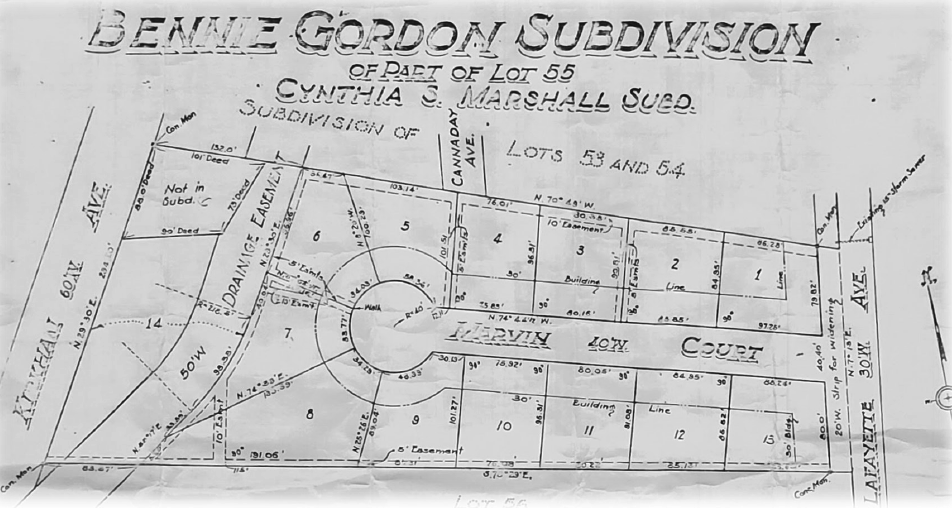
Plat Map of the Bennie Gordon Subdivision
It took me a while to learn what that was. It was a property development conceived by Bennie Gordon, Jr., builder – thirteen starter homes, named for Mr. Gordon’s second son, which were to be built by Mr. Gordon around a cul-de-sac on previously vacant land. Advertisements I later found in the St. Louis Argus, American, and Post-Dispatch from 1956, promoted this development as ideal for first-time African American homebuyers. He built the demonstration home, in hopes of getting contracts with buyers for the other twelve dwellings. And although he had experienced some challenges at first with the City Planning Commission and Council, the future in mid-1956 seemed bright.
Sidenote: Further reading of the court summary informed me that the 13-acre, triangle-shaped neighborhood – bounded by Kirkham on the west, Lafayette on the east, and Bennie Gordon’s subdivision on the south – was the farthest east portion of North Webster, the historically Black section of Webster Groves… and had been for about 30 years.
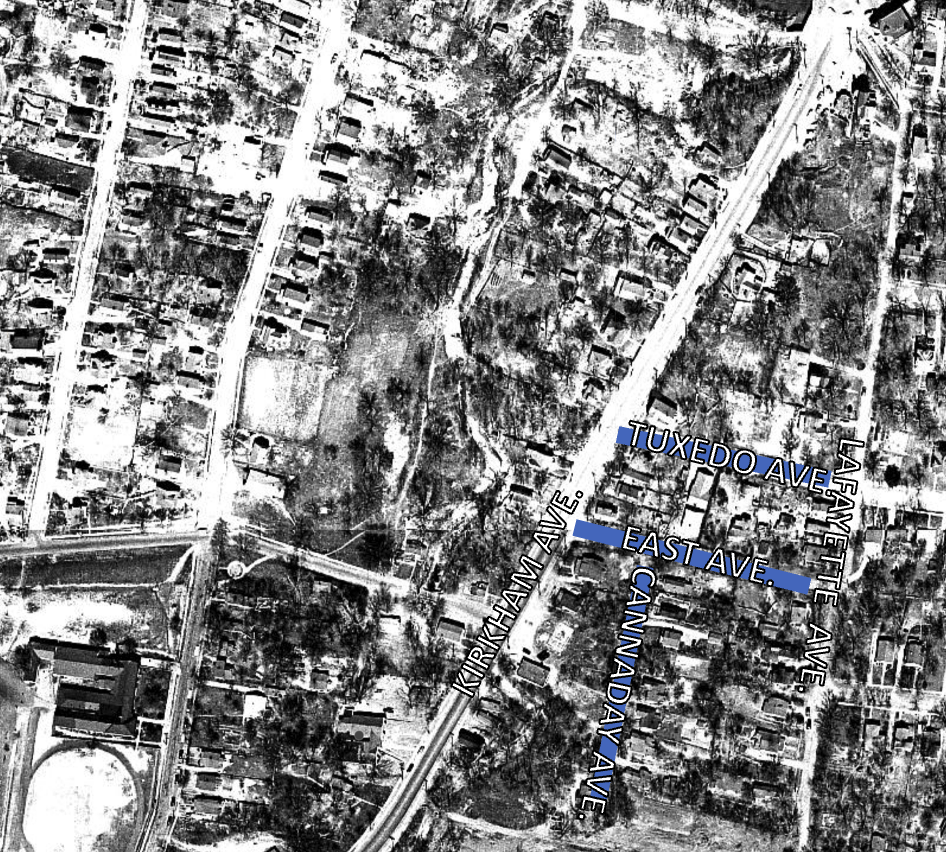
Aerial photo of 13-acre area (1955). Gordon Subdivision is the cleared land at bottom right. Douglass H. S. and athletic fields are at bottom left.
Since 1927, following the construction of the new houses of worship for First Baptist Church and what would become Parks Chapel African Methodist Episcopal Church, and the opening of Douglass High School, residential properties in this triangle were sold or rented to African American families by their former Danish occupants. In addition to the residences, Black-owned businesses – groceries, cleaners, restaurants, a night club, auto repairs, a taxicab company, barber shops, a doctor’s office, and a funeral home – moved in, on either side of Kirkham Avenue (now Brentwood Boulevard). Until 1960, this would be THE historic, economic center for North Webster.
Meanwhile, since the 1930s in the same general vicinity, property development of homes similarly affordable to those Mr. Gordon proposed to build had been constructed for and marketed to potential white residents of Webster Groves. These were new properties along Corona Court and Newport Avenue. All of these developments – Corona Court and Newport, and especially Marvin Court – were part of a general effort to increase the amount of new housing stock in Webster.
Consistent with this movement, in 1952, Webster Groves became part of the nationwide movement for urban renewal. Federal funding was being made available to municipalities across the country to make improvements to homes, businesses, and municipal areas that had had fallen into disrepair or needed city services. To take advantage of this, and to combat what was widely considered “urban blight,” Webster voters on April 1, 1952, overwhelmingly approved Ordinance No. 5917, creating a Land Clearance for Redevelopment Authority of their own.
It was undoubtedly because he could recognize the intentions of the City for federally funded economic and property improvement that Mr. Gordon purchased that swath of land. But he wasn’t interested in federal funding. He set out as a resident of North Webster to demonstrate that Black people themselves, Black business, could improve the lives and living of other Black people.
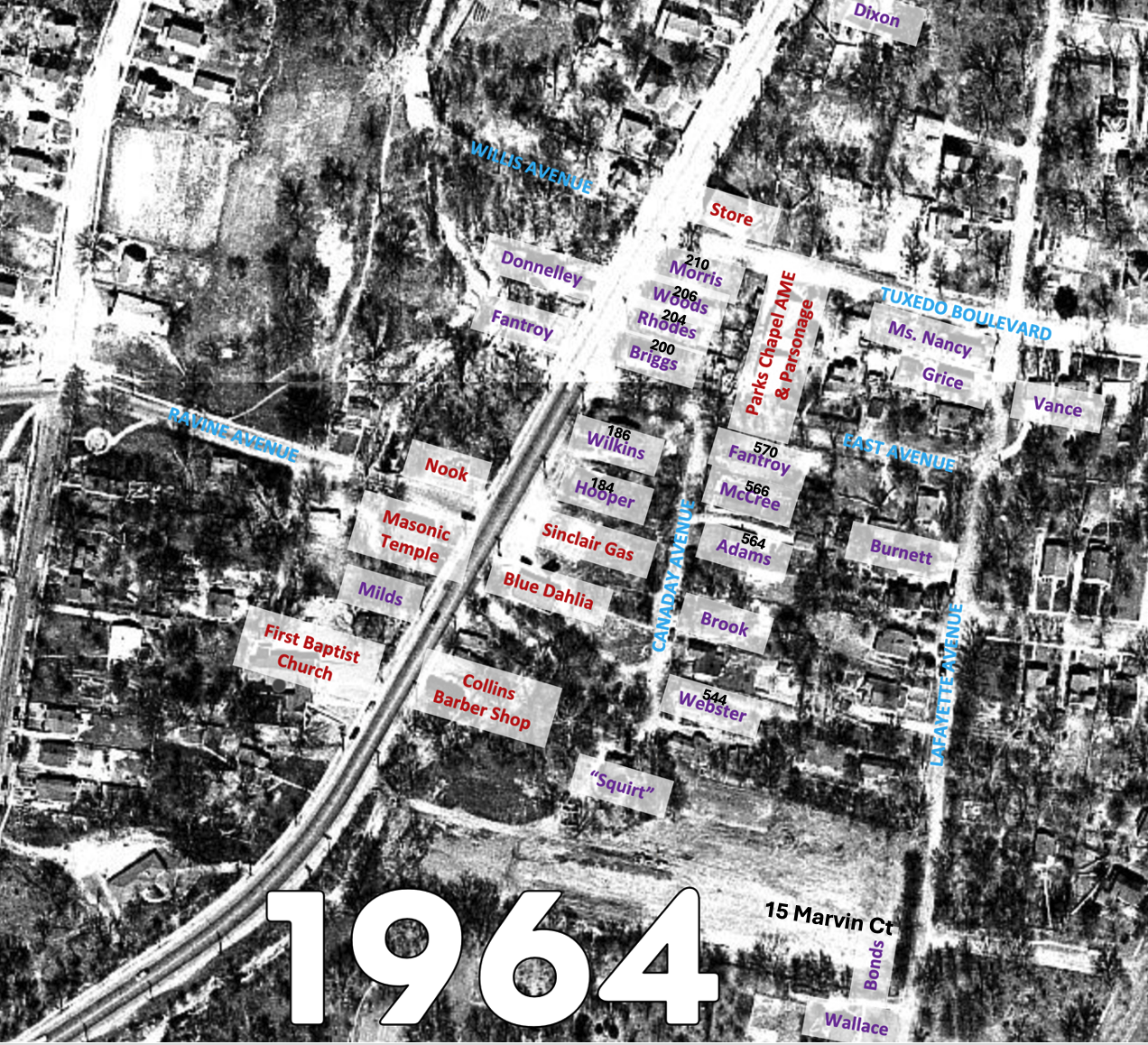
1955 Aerial photo with names of some of the families and businesses in the 13 -acre area, as of 1964, as remembered by the Wilkins family
He had grown up in North Webster; he knew personally the so-called blight the LCRA would seek to remedy. By his own testimony, he had grown up in some of the worst housing Webster had to offer, and he was intent to assure that no one in Webster should ever again have to live as he had lived when he was a child. The success of Marvin Court would be just the beginning of true community renewal led by North Webster for North Webster. I do believe, that was his plan when he broke ground in 1954 for his development.
From 1953 to 1957, Bennie Gordon, Jr., fought for his subdivision. He was first told by the City that he couldn’t extend Marvin Court across Shady Creek to Kirkham; so he complied by making it a cul-de-sac. Then, they said that his properties were too small, and then that they were facing in the wrong direction, given the shape of the properties. Mr. Gordon fought for his development, made further adjustments, received exemptions, and eventually he managed to build the first home on Lot 13 – 15 Marvin Court.
Meanwhile, white neighbors to the south on Lafayette Avenue, and along Newport Avenue between Lafayette and Glen Park, threatened Mr. Gordon’s lending institution with boycott if it did not withdraw its funding for the subdivision. They put “For Sale” signs in their lawns during open houses, and generally made it clear that they opposed this perceived expansion of North Webster.
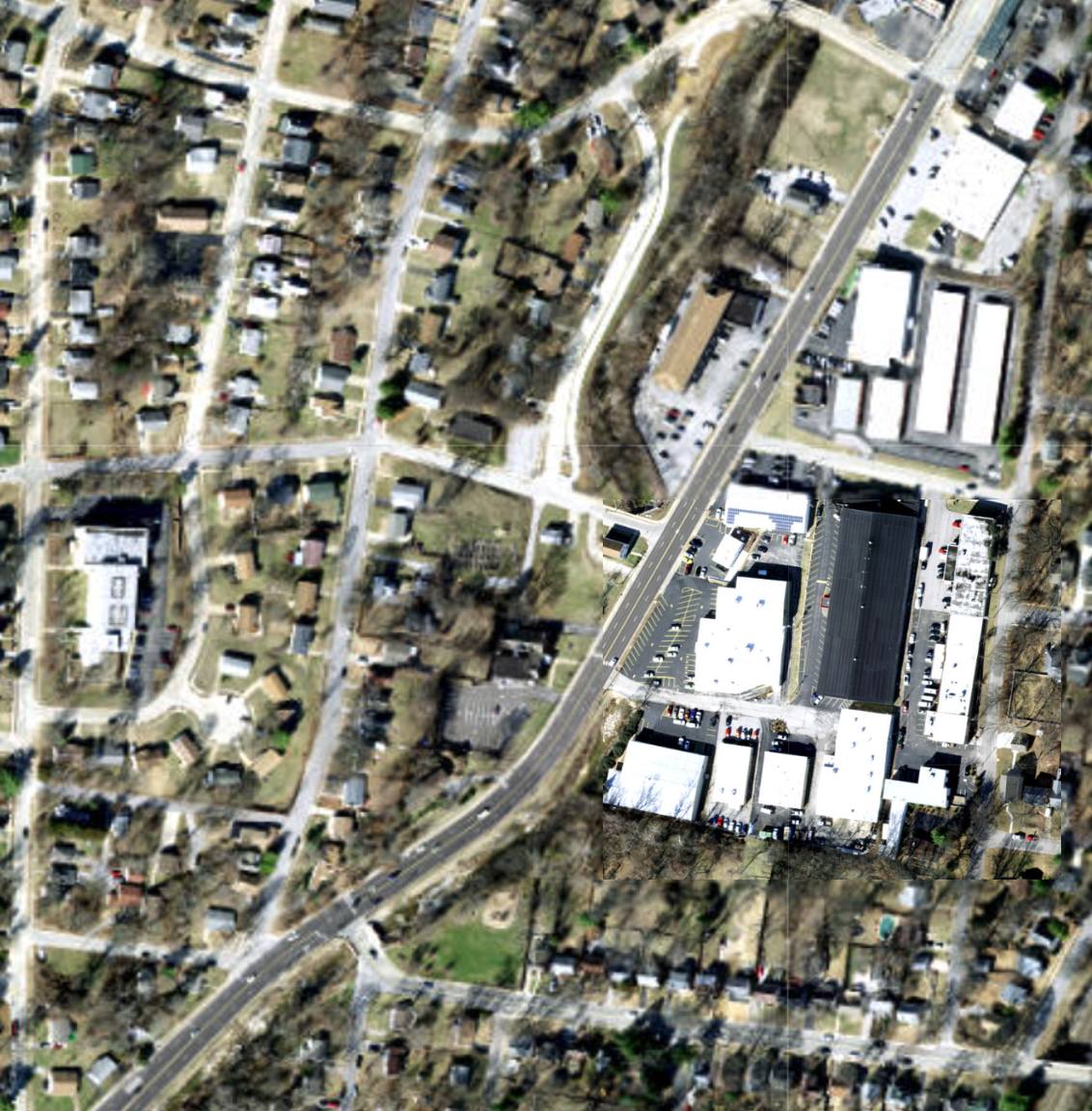
Aerial photo of redeveloped 13 acres and surroundings (2016). Note the Bonds home at bottom right of industrial court. Other houses built by Mr. Gordon are on the cul-de-sac at left where Douglass H. S. used to be.
Recognizing the familiar direction of proverbial winds, Mr. Gordon finally gave up hope for Marvin Court and at the end of 1956 sold the demonstration home to the Bonds family. By 1959, a Rehabilitation Study by the LCRA included five of the Marvin Court properties in a proposed industrial park that would replace the 30 homes and many businesses on the east side of Kirkham. The next year, 1960, all of Bennie Gordon’s Subdivision would be condemned… all except that nice, new little place the Bonds family lived in. By the way, if you find yourself wondering why there are so few (which is to say, no) Black-owned businesses in Webster Groves today, when North Webster had, until 1960, literally dozens… the answer would seem to lie in our plans for urban renewal.
It was because of conditions created by the LCRA that the Bonds family eventually sued the City in 1968. Kassandra and her sister Gayle grew up, playing in the gullies and the dirt piles that surrounded their home to the north and the west. No trees, no grass, no friendly streets, just land waiting to be paved over and developed into the industrial park we know today.
But I suggest that this narrative is not about defeat… because…
On the other hand, in 1957 the Willis family – who had previously lived in that neighborhood leveled by the City – bought the house next door to the Bonds’ on Lafayette. The white family that had been living there followed through on their threat to sell. Then, the Wilkinsons bought the vacant property next to the Willises and built a new home there. Mr. Dixon, whose home in the 13-acre triangle also was razed – after suing the City over where he would be permitted to buy a home – eventually was able to purchase one just across Lafayette on Fairview. Mr. Brock as well. So maybe, even though he hadn’t been able to pioneer redevelopment of North Webster by North Webster, Bennie Gordon, Jr.’s industry and entrepreneurism would eventually prove contagious and lead to the integration of the very neighborhood that had refused him the opportunity.
And, as one might have expected, after a time of disappointment, Mr. Gordon would finally be able to build some houses in North Webster, most notable among them properties in a subdivision where Douglass High School used to stand.
That is who – along with Ben and Gianis and Keith and, by extension Marvin, and the Bonds family – I have come to know, since Thanksgiving 2023.
We are here to honor That Man, that business man, that visionary, that activist, that hero – Bennie Gordon, Jr., and to name this place for him, so that none of his story should ever be forgotten.